Integration is not a slogan. In finance it is plumbing, interfaces, and rules that actually work under stress. When people talk about “blockchain in TradFi,” they mean changes to that plumbing, not a new coin to trade.
The useful line is clear. Distributed ledgers, tokenisation and programmability sit on one side. Speculation in crypto assets sits on the other. Keeping them apart is the first step to any serious plan.
What integration actually means
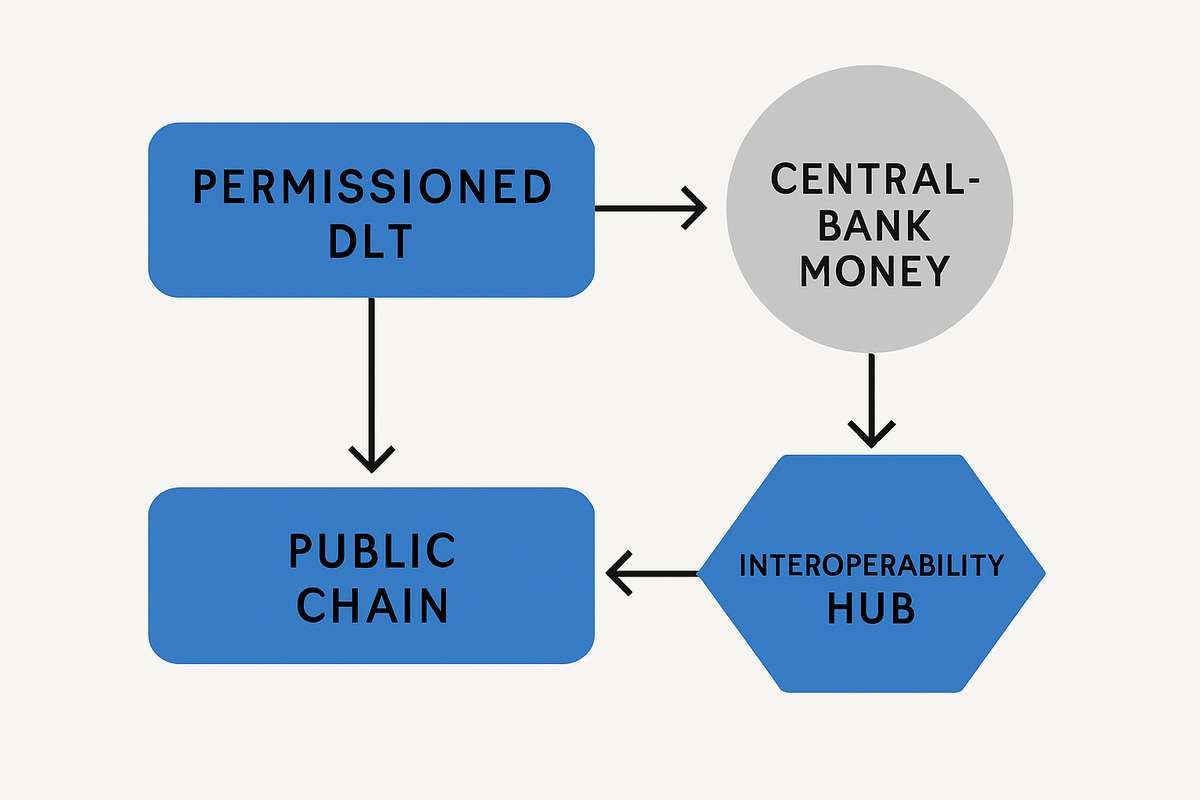
Traditional finance already runs on ledgers, messaging networks and control gates. Integrating blockchain means swapping or augmenting those parts with distributed ledger technology where it helps reconciliation, atomic settlement, or asset servicing. The Bank for International Settlements framed this years ago as a set of concrete trade‑offs around speed, cost, and control, not a revolution overnight BIS CPMI analysis of DLT in payments and settlement.
In practice, the touchpoints are specific. Settlement and clearing, where finality and delivery‑versus‑payment rule the day. Custody and asset servicing, where entitlements, corporate actions and lending are tracked. Messaging and reconciliation between institutions, where duplicate records are a tax on time.
Tokenisation turns claims into programmable objects on a ledger. That only scales when it links to money that actually settles. Central‑bank money, or its wholesale digital form, is the anchor many central banks have in mind because it solves finality and alignment with supervisory access at the core.
This is why permissioned networks keep showing up in pilots. They let firms model governance and data access to match existing rules, rather than rewrite the rules for a public chain. The cost is complexity in interoperability and a need for shared standards.
Why it matters now
The drivers are no longer theoretical. Tokenisation promises fractional ownership, easier distribution and new liquidity pools, which is why a leading asset manager framed it as a path to broaden access and tie into existing platforms like Aladdin, with identity and KYC as the gating factors BlackRock’s annual letter on tokenization.
Banks have not stood still. Large institutions have piloted interbank messaging, intraday liquidity tools and tokenised repos to compress reconciliation steps and speed settlement inside closed networks. These projects show how operational wins appear when the ledger can coordinate participants and reduce duplicate record‑keeping.
Central banks add a second push. Wholesale CBDC experiments aim to plug tokenised assets into money that settles with legal finality under the supervisor’s eye. That design choice tackles a stubborn risk that private stablecoins or deferred netting cannot always remove.
For investors and product teams, the near‑term use cases look familiar. Faster post‑trade, simpler servicing, and programmable cash flows beat abstract promises. If you are weighing the product lens, our explainer on tokenized assets’ opportunities and risks has a pragmatic checklist. If you focus on monetary design, see how ledger money changes portfolio mechanics in our CBDC brief.
The frictions that slow adoption
The speed story is attractive, but the frictions are old and hard. Interoperability between ledgers and legacy systems is not a user‑interface task, it is a consensus and standards problem. The BIS flagged this early, along with open questions about finality, governance and alignment with existing financial market infrastructure standards BIS CPMI on DLT benefits and frictions.
Regulators face their own bind. The EU’s pilot regime for DLT market infrastructure highlights the balance between protecting market integrity and letting industry try new rails. The report underscores guardrails around trading and settlement, and the boundaries of investor protection in testbeds ESMA’s DLT Pilot Regime report.
Cross‑border projects add more layers. Finality is legal, not only technical. AML/CFT, data residency, and the ability of supervisors to access records must travel with the tokens. Experiments that span jurisdictions need harmonised rules, or they stall at the first handoff.
Privacy and transparency look like a paradox. Public chains are transparent by default, which helps audits, but that can leak trading intent and client data. Permissioned designs control visibility, yet then must prove to regulators that records are complete and accessible when needed.
| Friction area | Why it matters | Design lever to test |
|---|---|---|
| Interoperability | Avoids fragmented liquidity and duplicate controls | Common messaging standards, connector hubs |
| Legal finality | Determines settlement risk and capital usage | Linkages to central bank money, clear rulebooks |
| Governance | Defines who can write, read, and upgrade | Consortium charters, on‑chain/off‑chain change control |
| Privacy vs transparency | Balances client confidentiality with auditability | Role‑based access, data partitioning |
| Supervisory access | Enables oversight and enforcement | Read‑only nodes, standardized reporting APIs |
Common misconceptions TradFi must unlearn
First, do not conflate cryptocurrency economics with ledger utility. A foundational critique pointed out the high volatility and narrow medium‑of‑exchange role of early crypto assets. That critique supports focusing on registries, settlement and servicing where ledgers help, rather than assuming a coin must sit in the middle.
Second, public‑chain transparency is not the same thing as regulatory suitability. Transparency can be a feature, yet regulated markets need controlled disclosure, redress, and identity‑aware workflows. Without those, the operational gains will not survive supervisory review.
Third, promised cost savings do not appear just by “moving rails to chain.” The BIS reminds readers that back‑office processes must be redesigned around the new data model, or the ledger only adds another system. The reward needs the hard work of de‑duplication, standardisation and change management across firms.
Finally, “code is law” is not a policy. Financial law is still law. Smart contracts help automate, yet legal finality, investor protection and dispute resolution remain off‑chain processes that the system must respect.
What experiments have shown
Central‑bank and industry pilots built a small but useful record. Cross‑border and wholesale projects such as Jasper, Helvetia and Stella tested tokenised settlement and showed that benefits are real when measured against accepted FMI standards. They also stressed how AML/CFT and legal design must be addressed before scaling.
Supervisors in Europe tried a formal sandbox. The DLT Pilot Regime set exemptions and control points for trading and settlement venues to test tokenised instruments. The early lesson is that regulatory design is an instrument in itself, with choices that trade speed for safety.
US researchers examined tokenised bonds on public chains. They found clear transparency benefits in tracking ownership and flows, but flagged privacy, oracle and custody risks that differ from conventional settlement. They also pointed to the need for supervised access that respects regulated market norms.
Banks piloted in production‑like settings. A major global bank used DLT for interbank messaging, intraday liquidity and tokenised repos, which cut reconciliation loops and time‑to‑settlement for known counterparties. That is the model for near‑term wins because it works within known legal and operational bounds.
Asset managers built product roadmaps around tokenisation. They focused on fractional ownership, broader access and new liquidity pools, while stressing that identity, KYC and integration with portfolio systems are gating constraints. Those constraints are not bugs, they are the features that let the products pass institutional review.
The risk map
Risks in hybrid architectures differ from both legacy and public‑only setups. Map them early and design controls into the pilot, not after the fact. That is also where good risk analytics and automation help — see our note on AI in risk management for tooling ideas.
- Privacy leakage: public traces can reveal strategy and client relationships even without names.
- Oracle and custody exposure: points where off‑chain facts meet on‑chain logic can fail or be abused.
- Market integrity: fragmented pools and inconsistent rules enable unfair access or manipulation.
- Operational resilience: permissioned networks can concentrate failure if governance and failover are weak.
- AML/CFT and KYC: identity gaps break compliance and limit distribution, even when the tech works.
Design choices help. Role‑based access, data partitioning and read‑only supervisory nodes keep oversight without full broadcast. Linking tokenised assets to central‑bank money, or to settlement assets with clear finality, reduces residual risk from deferred nets. Clear on‑chain/off‑chain change control supports auditability when smart contracts upgrade.
Check how disciplined your operating model really is. If every exception still goes off‑chain into email, you have not integrated anything yet.
Policy trade‑offs and counterarguments
Supervisors face a familiar choice. They can preserve market integrity by insisting on interoperability, supervisory access and alignment with existing FMI standards. Or they can open sandboxed pilots that relax constraints to measure benefits, while keeping investor protection in view.
A central‑bank view adds a system lens. Tokenisation and DLT look most powerful when tied to central‑bank money and common standards, which helps avoid fragmentation. That is less exciting than “open everything,” but it is how payment and settlement work at scale.
Scepticism is useful ballast. Economists have long noted that crypto assets do not fix money’s core functions, and that security and insurance gaps loom large. Those points push the debate back to where ledgers help: coordination of records, programmable servicing and safer settlement.
None of this kills innovation. It does sort proposals into ones that reduce frictions in the current system, and ones that try to replace the system. The former have a path. The latter meet courts and capital rules.
A pragmatic roadmap for integration
Start with standards and supervision. Build pilots that meet existing FMI requirements on governance, finality and oversight. Invite supervisors early, document change‑control, and plan read‑only access for regulators so they can test on their own.
Prioritise money that settles. If you can link to central‑bank money or a wholesale CBDC, do it. If not, use settlement assets that have clear legal finality, and model liquidity and intraday credit lines in detail.
Redesign the back office before you cut code. Decide which reconciliations to delete, which messages to standardise, and which controls to automate. The ledger is only as good as the operating model that surrounds it.
Treat interoperability as a first‑class workstream. Align message formats, interfaces and identity frameworks with peers. Consider connector hubs if you run more than one network, and push for shared standards in industry groups.
Invest in identity plumbing. The industry has told you the constraint is KYC and distribution. Build those rails at the start or your tokenised products will stall in onboarding, no matter how elegant the smart contracts are.
Choose use cases with clear sponsors. Interbank messaging and intraday liquidity have owners and measurable KPIs. Tokenised repos and collateral moves can compress timelines and free capital inside permissioned walls. That is how early bank projects got traction.
Measure, publish, and adapt. Sandboxes and pilots exist for a reason. Use them to quantify net benefits and stress points, then graduate winners into production with clear legal and operational guardrails. Ready to move beyond a proof of concept? Pressure‑test your thesis against our guide to evaluating tokenized assets.
Related reading
- Evaluating Tokenized Assets: Opportunities and Risks in a Digital Economy
- The Impact of Central Bank Digital Currencies on Traditional Portfolio Strategies
- The Future of Finance: Integrating AI into Risk Management Frameworks