Most firms already run machine learning somewhere in their risk stack. A few use large language models to triage incidents or summarise exposures. Integrating AI into risk management is no longer a slide in a strategy deck, it is an operating decision with system consequences.
It forces a shift in how we define model risk, how we think about data and fairness, and how we design markets that remain stable when many participants use similar algorithms. The good news is we have a workable blueprint.
What “integrating AI into risk management” actually means
Integration means embedding AI into the decision loops that identify, measure and control risk. It covers credit underwriting, market surveillance, stress testing, fraud detection and operational risk triage. The technologies span rule‑based systems, supervised and unsupervised ML, and generative AI with agentic tools, a taxonomy mapped across intermediation, insurance, asset management and payments by the Bank for International Settlements. See the BIS review of AI generations and financial domains in BIS Working Paper No. 1194.
This is not a monolith. A credit model that predicts default is different from an agent that negotiates margins, which is different from a retrieval system that explains a regulatory breach. The framework must recognise these differences, because the control set for each class will not be the same.
The objective is simple to state. We want better signals and faster detection without importing new fragilities, whether those come from data bias, black‑box opacity or herd behaviour across models.
Why it matters now: adoption and systemic stakes
Adoption is mainstream. A 2020 central‑bank survey reported that around 80% of institutions were formally discussing big‑data and ML projects, which marked a rapid uptake in a conservative sector. That shift changes the question from “if” to “how” and “at what scale”.
Scale brings new stakes. When many firms adopt similar models, errors can be correlated and shocks can propagate through connected markets, a theme highlighted by the mapping of model herding and network risks in BIS Working Paper No. 1194.
Architecture also matters at the system level. Research from the European Central Bank argues that different agent designs can produce distinct coordination and redemption dynamics, which means scenario design must be architecture‑aware to preserve stability.
Industry governance is evolving in response. A recent response to a policy request outlines a human‑first model where teams own AI risk, a central group provides oversight and an independent audit layer reviews controls, with explainability, bias and third‑party risk as key checks, as described in BlackRock’s RFI response.
For investor‑facing teams, adoption also intersects with behaviour. Our earlier analysis on behavioral finance and AI shows how algorithmic tools can dampen bias while introducing new ones if governance is thin.
The anatomy of AI risk in finance
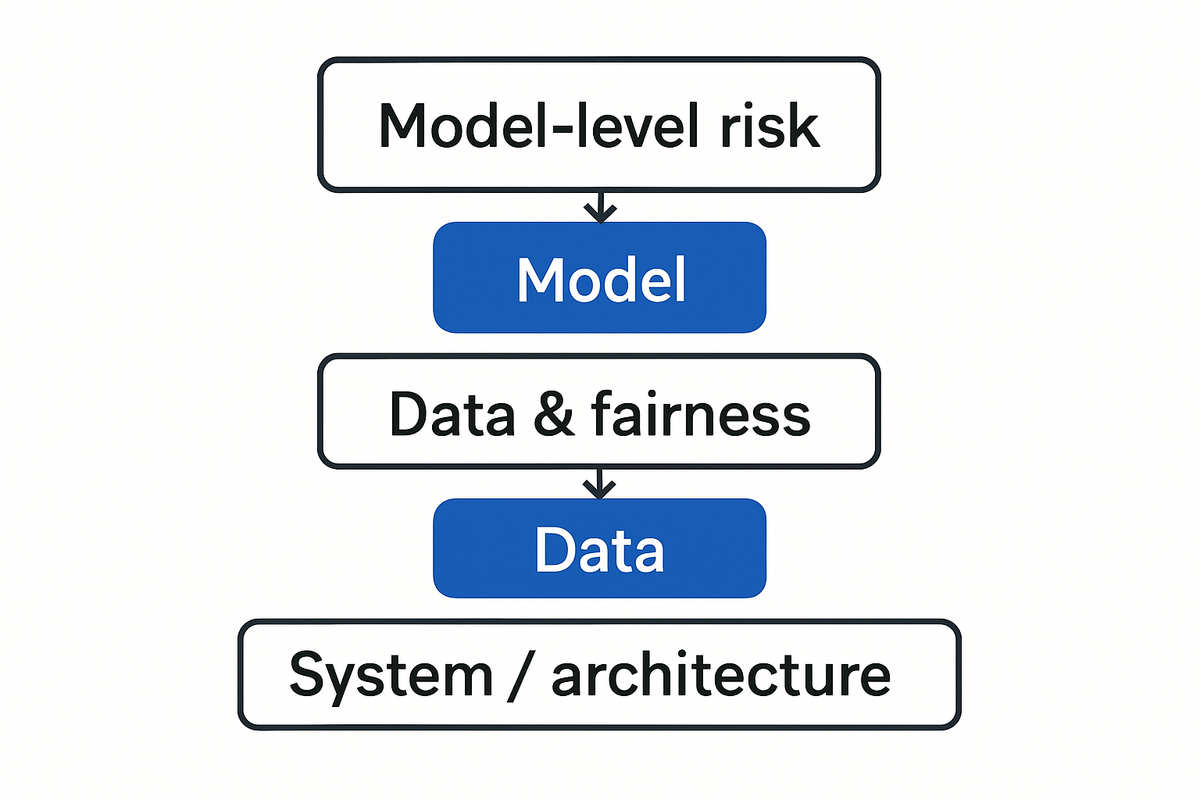
It helps to separate risk into three layers. First, model‑level risk, which comes from opacity, instability and distribution shift. Second, data, representativeness and fairness issues. Third, system‑level risk driven by the architectures that interact in markets.
This taxonomy is not academic for its own sake. Each layer suggests a different control surface, a different cadence of tests and a different accountability chain.
The following table links categories to first‑line controls and second‑line tests. It is a starting point, not an endpoint.
| Risk layer | Primary failure modes | First-line controls | Second-line tests |
|---|---|---|---|
| Model-level | Opacity, overfitting, distribution shift, hedging errors | Model inventories, champion–challenger, interpretability constraints | Robustness checks, out-of-sample stress, sensitivity and stability analyses |
| Data/fairness/privacy | Poor quality, non-representative samples, leakage, legal/privacy constraints | Data dictionaries, lineage, sampling audits, consent management | Bias metrics, subgroup performance, privacy risk review |
| System/architecture | Coordination failures, model herding, feedback loops | Diversity of signals, architectural guardrails, market anchors | Agent-based scenarios, circuit-breaker drills, cross-entity contagion mapping |
Model‑level risks: opacity, distribution shift and hedging consequences
Black‑box ML can degrade pricing and hedging if the training distribution does not match the live one. Opacity also makes it difficult to trace why exposures move the way they do, which complicates control. The literature on black‑box model risk in finance catalogues these origin risks and their consequences for hedging performance.
Mitigations exist. They include robustness testing under alternative distributions, stress sets that mimic regime change, and explicit interpretability constraints baked into backtesting regimes. These are not optional add‑ons, they are the work.
Data, representativeness and fairness
Central‑bank surveys flagged data quality and representativeness as the most common operational challenges for ML projects. Legal and privacy constraints limit which variables can be used and how they flow across the organisation. That combination can produce models that are both brittle and biased if left unchecked.
The fix is boring and essential. You need data dictionaries, lineage, access governance and audits of sampling and leakage. Bias needs to be measured on subgroups, not just on averages.
Systemic and coordination risks from architecture
Agent design changes market dynamics. Research shows that Q‑learning agents, which learn by trial and error, and LLM‑based agents, which reason over prompts and context, can coordinate and redeem in different ways. If many participants deploy similar agents, the resulting dynamics can amplify shocks.
The BIS review adds a network perspective — model herding and connectedness increase the chance that an error in one model becomes a sector event. If you run big models in connected markets, you owe the system a plan for how they might fail together.
Anchors and circuit breakers help. They are not elegant, they are effective when coordination breaks.
Common misconceptions to discard early
Explainability is not a cure‑all. Tools like SHAP and LIME explain local decisions well, but they do not guarantee global model stability or fairness, as shown in Explainable AI in Credit Risk Management.
AI does not remove human judgement. A leading asset manager’s governance model places ownership with the teams who use AI, backed by central oversight and independent audit, which affirms that accountability remains human, see BlackRock’s governance pattern.
ML projects are not purely technical. Successful deployments align prediction tasks to business metrics, build repeatable data flows and define how decisions will be taken and reviewed. That is an organisational change as much as a modelling one.
Finally, “more data fixes bias” is not a law. If the sample is mis‑specified or consent is missing, more of the same can entrench the problem.
The toolkit: governance, XAI, MLOps and model‑risk controls
Start with governance. A human‑first operating model assigns day‑to‑day risk ownership to domain teams, sets central oversight for standards and inventories, and adds independent audit, with explainability, bias and third‑party risk on the checklist. That pattern is documented in BlackRock’s RFI response and fits the system‑risk concerns outlined in BIS Working Paper No. 1194.
Add explainability where it helps the decision. In credit, SHAP values are useful for reviewing an adverse decision and for portfolio‑level drift analysis. LIME can support case‑by‑case escalations. Both come with caveats, and both need calibration.
MLOps closes the loop. You need versioned data and models, continuous monitoring of inputs and outputs, drift alarms, rollbacks and a model inventory. Without this, you will not know whether you are measuring model change or market change.
Bias controls sit across layers. If you want to reduce behavioural errors in investment committees, connect model outputs to prompts and guardrails that nudge decisions, drawing on ideas from behavioral finance and AI.
Check how disciplined your portfolio really is.
Explainability in practice: trade‑offs and deployment caveats
SHAP delivers consistent local attributions under strong assumptions and scales to portfolio summaries. It helps stakeholders see which variables contributed to a score and by how much. LIME can be faster for case review and sandboxing alternative explanations, as demonstrated in the comparative study on credit risk.
Beware the gaps. Local explanations do not imply global fairness or stability. Kernel choices and neighbourhood definitions change narratives, so governance must lock them, test them and document them.
Explanations must be decision‑useful. If reviewers cannot interpret a SHAP waterfall, then the process fails even if the math is correct.
Model validation, robustness tests and distributional stress
A modern validation stack goes beyond accuracy. It tests sensitivity to perturbations, robustness to alternative distributions and stability of rankings. It also enforces interpretability constraints to make backtests meaningful.
Distributional stress is not an afterthought. You should replay past regime shifts, simulate plausible future shifts and run champion–challenger bake‑offs. The black‑box model risk literature highlights how these steps catch hedging errors before they become P&L events.
Finally, document the edge cases you refuse to automate. That line protects both customers and capital.
Architecture‑aware stress testing and market‑design levers
Scenario libraries should reflect agent behaviour, not just macro shocks. If your liquidity providers run Q‑learning style agents, rehearse trial‑and‑error cascades. If large asset managers deploy LLM‑based agents for reasoning, rehearse prompt‑driven coordination and the risk of sudden redemption cues.
System safeguards are part of design. Anchors give agents stable focal points and circuit breakers pause destructive feedback. The ECB’s work argues these levers change coordination dynamics in useful ways.
Compose tests that cut across entities. Herding risk emerges when similar models face similar signals. That is a market‑level property, not a firm‑level bug.
This is also where risk and market design meet dynamic policy. For a portfolio context, see how dynamic risk management techniques complement architecture‑aware stress.
Case studies and empirical evidence
Central banks are not on the sidelines. A 2020 survey found that around 80% were formally discussing big‑data and ML projects, which is high given their mandate and risk tolerance. That legitimises AI in prudential contexts and pressures firms to match the pace.
Industry governance is converging. A large asset manager documented a governance stack with team ownership, central oversight and independent audit, plus controls for explainability, bias and vendor risk, see the BlackRock RFI response.
Sector‑specific integration is practical. In private credit, investors can score AI disruption risk for software borrowers using leading indicators like net revenue retention and client churn, then align disruption timelines with loan maturities and design stress scenarios that match those horizons. That framing turns vague “AI risk” into covenant‑relevant monitoring.
The system lens is not theoretical. Architecture choices changed redemption dynamics in agent studies, so supervisors and risk teams need tests that reflect those behaviours, not just shocks to GDP or rates.
A practical roadmap: implementing an AI‑aware risk framework
You can implement this with a stepwise plan. Start with a clear prediction task, the decision it informs and the metric that defines success. Build data pipes with lineage and access control. Decide how models will be deployed and who can override them.
Then layer governance, XAI and validation. Assign team ownership, set central standards and create an audit calendar. Choose explainability tools fit for purpose, set kernel and background distributions, and train reviewers.
Finally, institutionalise monitoring and stress. Track input drift, output drift and stability of rankings. Build an architecture‑aware scenario library and rehearse circuit‑breaker actions. The BIS review underlines the need for upgraded governance across this lifecycle, see BIS Working Paper No. 1194.
Here is a compact checklist you can reuse.
- Define prediction task, decision, and KPI.
- Map data sources, lineage, access and consent.
- Select model class, baselines and interpretability constraints.
- Establish team ownership, central oversight and audit cadence.
- Implement SHAP/LIME for case review and portfolio drift.
- Validate with robustness, distributional stress and challenger bake‑offs.
- Monitor input and output drift with thresholds and alerts.
- Run architecture‑aware scenarios and circuit‑breaker drills.
- Review fairness on subgroups and document overrides.
- Maintain vendor and third‑party risk registers for AI components.
Set three success metrics from day one. Decision lift against the baseline, stability of model rankings through mild regime shifts and time‑to‑detect anomalies. If you cannot measure these, you are not ready to scale.
Audit your AI pipeline this quarter.
For more context on investor workflows, see our explainer on the rise of AI in risk assessment.
Closing synthesis and tensions to watch
AI can improve signal extraction and shorten detection time. It also concentrates decision logic into shared models and platforms, which raises the odds of correlated errors and coordination failures.
The path forward blends governance, architecture‑aware stress testing and market‑design levers. It is less about finding a perfect model and more about building a resilient decision system, a message reinforced in BIS Working Paper No. 1194 and in the industry’s emphasis on human‑first accountability in the BlackRock paper.
If we get those ingredients right, we can use AI to reduce risk rather than relocate it.