Passive has become the default setting for many portfolios. That shift raises an old question with new urgency: do passive flows help prices reflect fundamentals, or do they add noise that others must clean up later. The answer is not a slogan. It depends on the instrument, the market and the moment.
We walk through what the best evidence actually says, where it is most convincing, and where caution still applies. Along the way, we separate the channels that move prices from the interpretations that try to make sense of them.
What we mean by “passive flows” and “price discovery”
By passive flows, we mean demand that tracks an index or a fixed formula. That includes ETF creations and redemptions, secondary‑market ETF trading, and the rebalancing of index funds around calendar events. The flows do not react to new information in the classic sense, yet they can still move prices.
Price discovery is the process by which trading causes prices to reflect fundamentals rather than transitory pressures. In ETF markets, two features shape that process. First, an arbitrage mechanism links ETF prices to the value of their holdings. Second, heavy secondary trading can transmit demand shocks back to constituents.
The landmark empirical review finds both sides at work. ETFs enhance information aggregation through arbitrage and added liquidity, but they also inject non‑fundamental volatility that tends to mean‑revert after the shock, as shown in the NBER study by Ben‑David, Franzoni and Moussawi.
A regulatory overview underscores that these effects differ by asset class. The BIS Quarterly Review by Sushko and Turner describes how ETF trading can alter correlations, liquidity patterns and the speed of price adjustment. It also notes that secondary‑market dynamics can matter for underlying assets when the wrapper dominates trading.
Why this debate matters now — scale, asset‑class concentration and tail risks
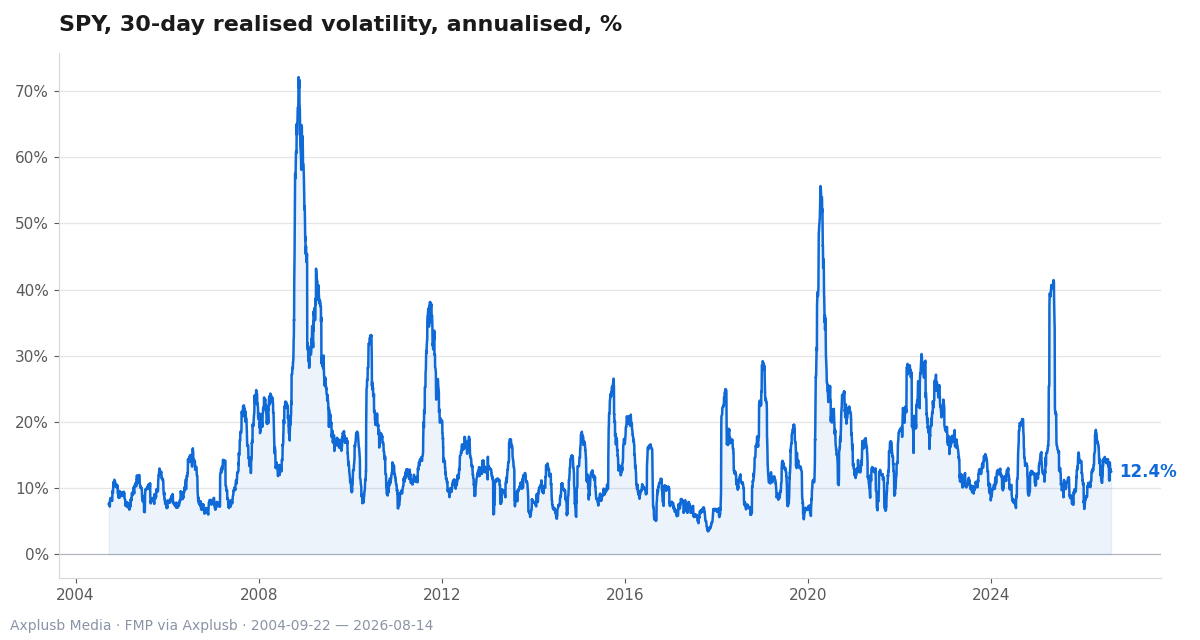
ETFs are no longer a sideshow. In some corners, they are the market. Where the wrapper’s share is high, flow pressure can be strong enough to leave marks on prices even when fundamentals are unchanged. That is not conjecture.
In VIX and commodity futures, where ETF penetration is very large, ETF activity materially affects the prices of the underlying contracts. The effect is tied to non‑fundamental components such as calendar flows, leverage resets and rebalancing mechanics, according to BIS Working Paper No. 952 by Karamfil Todorov.
Fixed income faces a different kind of fragility. Underlying bonds can be hard to source or slow to trade, so closing auctions and index turn dates can concentrate execution when flows are one‑way. Practitioner evidence warns that passive flows can amplify inelasticity in bonds and raise tail risks when the direction reverses.
The policy lens matters because the stress does not fall evenly. Equity ETFs enjoy deep single‑name markets and low‑friction arbitrage in normal times. Bond and volatility‑linked products must work through inventory, dealer balance sheets and, at times, scarce collateral. The mix of tools that keeps prices informative is therefore market specific.
The mechanical channels: arbitrage, secondary‑market trading, rebalancing and inelasticity
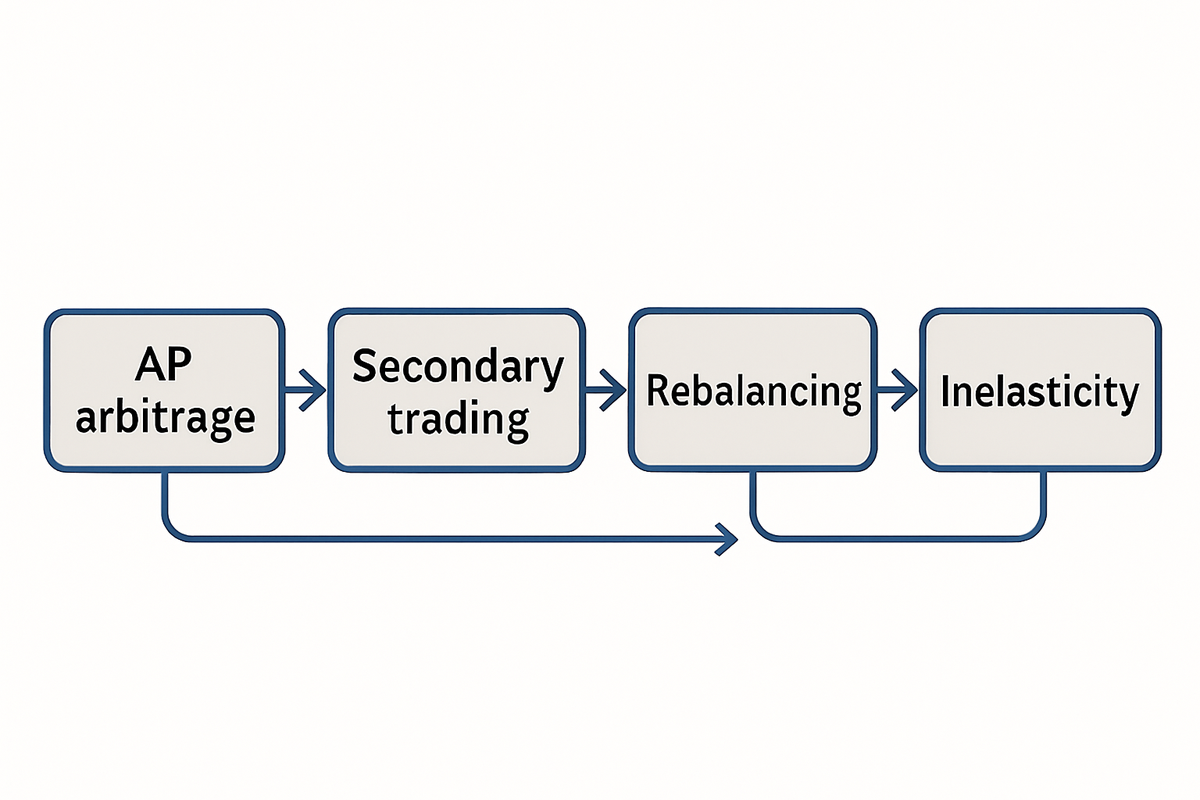
There are four main routes from passive flows to prices. First, the ETF arbitrage link that authorises creations and redemptions keeps ETF prices close to their net asset value. When ETFs are liquid and their constituents trade easily, this mechanism supports price discovery by directing informed flow to the cheapest route.
Second, heavy secondary‑market trading can transmit its shocks to the basket. Demand for the ETF share itself may prompt arbitrage activity that moves the constituents, even if no new information about fundamentals arrived. That pressure often fades as inventories rebalance and arbitrage capital works.
Third, predictable rebalancing can create calendar effects. Index turns, quarter‑end flows and the daily mechanics of leveraged and inverse products can push prices away from fundamentals for a time. The more concentrated the product set and the tighter the trading window, the larger the footprint on prices.
Fourth, arbitrage strength is conditional on underlying liquidity. Using trade‑level data, research shows that when constituents are less liquid, liquidity spillovers run from the holdings to the ETF shares and distortions can persist for longer, as documented in the Federal Reserve FEDS study by Rappoport and Tuzun.
These channels are not mutually exclusive. They often overlap on the same day. They also cut both ways. AP arbitrage and intraday quotes can improve signals, yet the same plumbing can carry flow shocks into fragile parts of the market.
| Channel | What changes | When it strengthens | Empirical anchor |
|---|---|---|---|
| AP arbitrage | ETF–NAV alignment, cross-market price checks | Liquid constituents, ample dealer balance sheets | NBER 2016 |
| Secondary trading | Demand shock in ETF transmits to basket | High ETF share, active secondary volume | NBER 2016 |
| Rebalancing/calendars | Predictable, non-fundamental flows | Index turns, leverage resets, narrow trading windows | BIS WP 952 |
| Inelasticity | Prices move more per unit of flow | Illiquid bonds or constrained inventories | FEDS 2020 |
Heterogeneity: why “passive” is not one thing
“Passive” is a misnomer for much of the ETF universe. Smart‑beta funds select and weight securities by rules that express views about quality, value, or momentum. Leveraged and inverse products run daily resets that force trades regardless of news. Active ETFs now sit beside index trackers in the same wrapper.
That heterogeneity reshapes the price discovery question. Some rules‑based funds supply structure to information revelation rather than destroy it. The Review of Finance work by Easley, Michayluk, O’Hara and Putniņš argues many ETFs behave actively, and that this activeness can preserve or increase price informativeness.
Asset class also matters. Bond ETFs face settlement frictions and uneven transparency across the holdings, so arbitrage can be slow or costly in stress. Commodity and VIX products may be large relative to their underlying markets, so levered and calendar-driven trades can imprint on futures curves.
Practitioners highlight the fixed income case in particular. The ETF wrapper can provide real‑time quotes and concentrate price formation in the share itself when the bonds are not trading, which can be useful for execution. Yet that advantage does not remove the inelasticity of the underlying market.
For allocators, that mix means the passive label reveals little about the likely price impact of a flow. Focus on the instrument’s mechanics and the liquidity of what sits inside the wrapper. Then ask when those frictions last mattered.
What the evidence actually shows — case studies and stylised facts
First, there are markets where ETF flows measurably add non‑fundamental price components. VIX and commodity futures sit at the top of that list. When ETF penetration is high, calendar and leverage‑related trading can move the underlying away from fundamentals before it mean‑reverts. BIS Working Paper 952 provides the most direct decomposition of those effects.
Second, ETFs can both improve and disturb price discovery in equities. Arbitrage and added trading venues help information get expressed, while demand shocks in the ETF share can press on the basket in ways that later reverse. The NBER evidence shows this dual effect with measurable post‑shock reversion.
Third, fixed income shows limits to arbitrage most clearly. The Fed’s panel study finds that when constituents are less liquid, spillovers and deviations from fair value are stronger and more persistent. That is a design and market microstructure story rather than an indictment of the wrapper.
Fourth, effects vary by context. The BIS survey emphasises cross‑asset heterogeneity in how ETF trading changes correlations and liquidity. Equity, bond, and volatility‑linked markets respond to the same plumbing in different ways because their underlying frictions differ.
These points are not mutually exclusive. Taken together, they draw a map rather than a verdict. The gains to price discovery are real, the fragilities are situational, and the worst distortions cluster where ETFs dominate trading in inelastic markets.
Competing interpretations and common misconceptions
Industry voices stress the benefits. The iShares policy work argues that ETFs provide intraday price signals, transparency and a shock‑absorber function through the creation and redemption process. It points to episodes where the wrapper traded and priced risk when the underlying was quiet.
Cautionary practitioner views focus on the other tail. T. Rowe Price warns that passive fixed‑income flows can amplify inelasticity, push more execution into closing auctions and raise the risk of sharp reversals when flows turn. The concern is not daily noise, but the shape of losses when liquidity vanishes.
The academic nuance sits in between. Many ETFs operate with active features, which can add to price informativeness rather than subtract from it. The dual effect in the data is also a warning against binary thinking. Improvement in one dimension can coincide with extra volatility in another.
A common misconception is that “passive does not trade.” Calendar rebalancing, leverage resets and the maintenance of index weights all require trading, even in a static allocation. Another is that ETF arbitrage always keeps everything lined up. The evidence shows it works well when liquidity is there and wobbles when it is not.
Limits, counterarguments and where evidence is thin
One limit is arbitrage capital itself. It is abundant in calm markets and scarce in stress. The Fed study’s liquidity dependence explains why mispricings compress quickly for large cap equity baskets and linger in parts of credit. That is a statement about plumbing capacity rather than belief in fundamentals.
Another limit lies in how concentrated ETF ownership is within an asset class. The strongest flow‑driven effects show up where the wrapper dominates, as in parts of the VIX and commodity complexes. The BIS working paper underlines the role of leverage and calendar mechanics in creating those distortions.
A counterargument claims that secondary trading in ETFs is mostly harmless because it nets out. The NBER evidence complicates that claim. Netting in the share can still prompt primary‑market activity once deviations open, and the constituent trades that close the gap are what move prices.
Where is the evidence thin. We know less about how smart‑beta and active ETFs transmit information across different market regimes, and how closing‑auction concentration evolves as passive share rises in specific bond sectors. We also lack unified measures of “passive intensity” that distinguish wrapper effects from broader indexing trends.
Practical conclusions — what regulators, asset managers and allocators should watch and do
Map concentration by asset class. Track where ETF share of trading is high relative to the depth of the underlying, and pay special attention to products with leverage or rigid rebalancing schedules. In those pockets, flows can become the story for short windows.
Probe the plumbing. In illiquid baskets, arbitrage depends on dealer balance sheets and settlement frictions. Execution policies should recognise that ETF quotes can be informative when bonds are quiet, yet still coexist with inelastic underlyings. Stress test your liquidity assumptions before the next rebalance.
Monitor the calendar. Index turns, quarter‑ends and daily resets can compress trade into narrow windows. That is when flow moves fastest and price discovery can wobble. Regulators and venues can help by improving closing‑auction transparency and ensuring enough capacity around known events.
Design with liquidity in mind. Index constructors and ETF sponsors can favour rules that avoid predictable, concentrated trading where possible. In fixed income, consider active or hybrid approaches that allow discretion on execution while preserving the wrapper’s operational benefits.
Allocators should match tools to markets. Use plain‑vanilla ETFs where arbitrage is strong and the basket trades cleanly. In inelastic markets, prefer vehicles that can adjust trading to conditions. Pair this with risk systems that flag when exposure to ETF‑dominated segments creeps up.
Finally, treat “passive” as a set of mechanics, not a philosophy. Ask what the wrapper does to price discovery in this market, on this day, under these constraints. Then decide whether the benefit is worth the added flow sensitivity. Check how disciplined your portfolio really is.
For readers building systematic processes, the interaction between flows and information is key. See how we frame these choices in our piece on ETF rotation with machine learning and how factor signals adapt in our survey of the evolving factor landscape.
Related reading
- Leveraging Machine Learning for Enhanced ETF Rotation Strategies
- Exploring the Evolving Landscape of Factor Models and Their Performance in Today’s Markets