Most investors know their own blind spots. Fewer ask how those same biases behave once they are wired into fast, scalable code. The age of AI is not only about better tools, it is also about new paths for old errors.
The question is simple enough. What happens to overconfidence, loss aversion, herding and confirmation bias when machines do more of the work, and do it together at scale?
Behavioral biases meet algorithmic scale
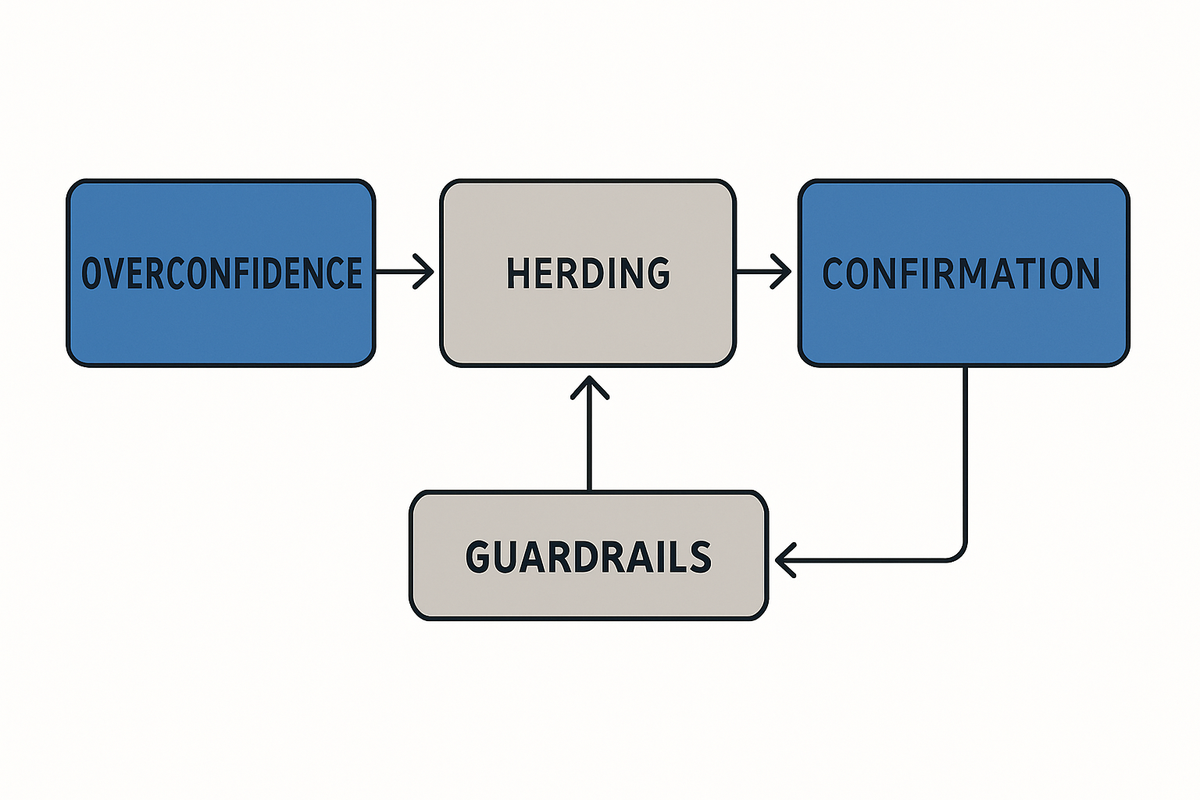
Behavioral finance gave us a map of human error. Overconfidence leads to high turnover, loss aversion skews risk, herding crowds trades, and confirmation bias narrows our field of view. AI changes the terrain because decisions move faster, get applied more consistently and reach more assets at once.
Regulators see both sides. One recent analysis argues that AI expands information power across finance, yet it also creates risks from model homogeneity, algorithmic bias, concentration and new stability channels such as model herding and lower explainability, as detailed by the BIS Working Paper No.1194.
The human and machine comparison matters. Work from a major central bank has stressed that machines can reduce some individual mistakes through speed and consistency. It also notes how narrow optimisation and shared models can align behavior across firms, raising the chance of synchronized moves that feel like herding.
Industry practice sits in the middle. Large asset managers describe AI reshaping research, risk and systematic processes. They also call out concentration risks and the need for governance, which is a sober view rather than a sales pitch.
If you want a practical bridge from psychology to process, see our review of Behavioral Finance and AI.
Why it matters now: exponential information power and new failure modes
AI does not trickle into finance, it scales. The same code can parse filings, scan news, rebalance factor sleeves and route orders. The gain is clear. The side effects matter just as much when many firms rely on the same data feeds, model classes or vendors.
The systemic view is now explicit. Research highlights how model homogeneity and lower explainability change how mistakes propagate across markets, as set out in the BIS analysis of AI in finance.
Practitioners add a ground truth. Markets are noisy and change over time. That means machine learning can overfit, models can drift and crowded trades can break at once. The sensible stance is to treat AI as a useful tool inside a wider, risk aware process.
To keep the moving parts straight, it helps to name them.
| Bias or feature | Human tendency | What AI changes | New risk channel |
|---|---|---|---|
| Overconfidence | Act on weak signals | More precise backtests and crisp outputs | False certainty from slick explanations |
| Herding | Follow the crowd | Faster, wider reaction to shared inputs | Algorithmic crowding across models |
| Confirmation bias | Seek agreeing evidence | Broader search across data | Filters trained on the same sources |
| Loss aversion | Cut winners, hold losers | Rule based exits and sizing | Forced, synchronized deleveraging |
| Speed and scale | Slow and varied | Fast and uniform execution | One‑way flows during stress |
| Explainability | Stories and narratives | Opaque model rationale | Harder oversight and accountability |
How AI can both damp and enable classic investor biases
Start with the good news. Machines do not feel fear or pride. They apply rules as written and do so on time. That alone can cut some micro level errors, such as anchoring on round numbers or waiting too long to exit a loser.
Now the caution. Consistent rules fed by uniform data can move many actors the same way. When models prize similar signals, you can get synchronised trades that resemble herding, only faster and with more size. That is the machine version of the old pit problem.
Both ideas appear in the theory. Comparative work argues that machines differ from humans in bias and memory, which can make them both steadier and more brittle. Narrow goals can create blind spots, and shared tools can sync those blind spots across many desks.
Here is the practical twist. AI can widen your lens if it is built to search broadly, and it can narrow your field if it is tuned on one stream. The design choice is the edge.
What the lab evidence actually shows
Claims about AI often confuse hope with proof. Controlled experiments help. One set of lab style markets with large language model agents finds that AI agents often rely on private signals and behave more rationally than naive human benchmarks, which dampens simple forms of herding, as shown in the FEDS 2025-090 study.
The same experiments also show how herding can emerge by design. When incentives changed, agents were induced to coordinate on herd like outcomes that were optimal within those rules. The point is not that AI herds by default. It is that context and incentives decide.
The authors shared open access materials that let others test the setup. Their preprint stresses reproducibility and nuance, which helps translate lab results to market settings, see the arXiv preprint version.
Taken together, the lab says two things. AI can reduce noise driven crowding when it uses better private signals. AI can also line up at the same door when the rules push it that way.
The human plus AI feedback loop: where machines amplify human faults
There is a quieter risk. People tend to trust confident answers, and AI is good at confident answers. Experiments with managers found that using generative AI could raise overconfidence and worsen forecasts when outputs were taken at face value. That is authority bias with a new face.
This is where design matters again. If a tool produces crisp prose with a single answer, users may skip doubt. If it shows uncertainty and asks for alternatives, users engage. The tool does not force the choice. The workflow does.
Comparative research on people and machines also calls for guardrails and oversight. Humans bring intuition and context, but they also bring mood and bias. Machines bring speed and consistency, but they also bring narrow goals and limited transparency. Each side needs checks.
You cannot outsource judgment to a model. You can design your process so that the model pushes you to ask better questions.
Common misconceptions investors bring to AI tools
The first myth is that AI is a debiasing magic wand. It is not. It can remove some noise and add fresh signals. It can also amplify errors if everyone uses it the same way.
The second myth is that more data always fixes the model. Markets change. A model that reads history well can look great in backtests and poor in live trades. Overfitting is confidence with a time delay.
The third myth is that AI is a free source of alpha. In truth, many AI ideas point to known factors or themes. If those ideas get crowded, spreads compress and risk grows.
The fourth myth is that transparency is optional. When you cannot explain a position, you are likely to sell it at the worst time. Explainability is not a toy feature. It is a control for panic.
For a human angle on stress and decision quality, see how fear and doubt spike in shocks in our piece on behavioral biases under uncertainty.
Industry responses and case studies: how asset managers are adapting
Look at what the big firms do, not what they say on stage. Leading managers describe AI as a way to scale research, risk and systematic methods. They also point to long term ownership, oversight and concentration risk as key themes in how they invest with these tools.
Systematic shops add another layer. They treat machine learning as a complement to existing signals and processes. They warn about crowded trades, overfitting and model change risk, and they spread bets across strategies to blunt those shocks.
This is a pragmatic middle path. Build more with code and data. Keep humans in the loop for goals, governance and exceptions. Stress test for model uniformity, and watch exposures that many others could share.
The result is not a shiny box. It is a portfolio that knows what it owns and why, and a team that knows what to do when the lights flicker.
Counterarguments and boundary conditions: when AI helps more than harms
It is easy to argue only one side. The evidence forces balance. In controlled markets, AI agents often avoid naive crowding since they use private signals. That is a real gain in settings where human herding would be strong.
Yet those same agents can herd when incentives make coordination pay. That is not a bug. It is a result of the rules, which in markets can mean benchmarks, flows or risk limits that many share.
Theory draws the same line. Machines can cut some human errors and still create new, system wide paths for stress. The risk is conditional rather than binary. It depends on incentives, shared inputs and governance.
So the right question is not whether AI is good or bad for behavior. It is when, where and under what rules it helps or hurts.
Practical playbook: governance, portfolio design and debiasing workflows
Here is a short playbook that blends the research into action. None of it is flashy. All of it is concrete.
Model governance that bites: – Record the hypothesis, signals and failure modes before a model goes live. – Require a plain language model card with known limits and links to tests. – Run pre trade and post trade checks for crowding and model herding.
Portfolio design that assumes change: – Diversify across independent signals and horizons to reduce one way exits. – Stress test for shared exposures, data feeds and vendor models that many could hold. – Size positions with exits that work under thin liquidity and faster moves.
Human in the loop, on purpose: – Add uncertainty prompts to AI tools and forbid one answer summaries by default. – Use structured peer review of AI driven calls with red team roles and veto rights. – Make users show alternatives, not just a single forecast, to cut confirmation bias.
Live risk practice: – Monitor model performance decay and drift with stop, pause or revise triggers. – Simulate incentive shifts that could push agents to herd, then build buffers. – Drill what to do in a model outage or a sudden crowd unwind.
- Insert a weekly “trust but verify” hour to review any AI suggestions that moved money.
- Keep a running “known unknowns” log for each strategy and revisit it monthly.
- Publish a one page “why we hold” note for every large position.
Two closing nudges. Check how disciplined your portfolio really is. Audit your models before the market does.
For a mindset tune up, try our guide to emotional discipline strategies.
Related reading
- Behavioral Finance and AI: How Technology Can Help Mitigate Investor Biases
- How Behavioral Biases Affect Decision Making During Economic Uncertainty
- Emotional Discipline: Strategies to Overcome Cognitive Biases in Investment Decisions