Digital money is not one thing. It is a range that runs from public money issued by a central bank to private tokens that ride on networks built by firms. The terms overlap in the headlines, yet the differences shape how we will all pay for lunch and settle trades.
The shift is not only about apps or a new currency logo. It is about what counts as final settlement and who bears risk along the way. It is also about which data trails we accept when we move value. That is why labels matter.
What “digital currencies” actually cover
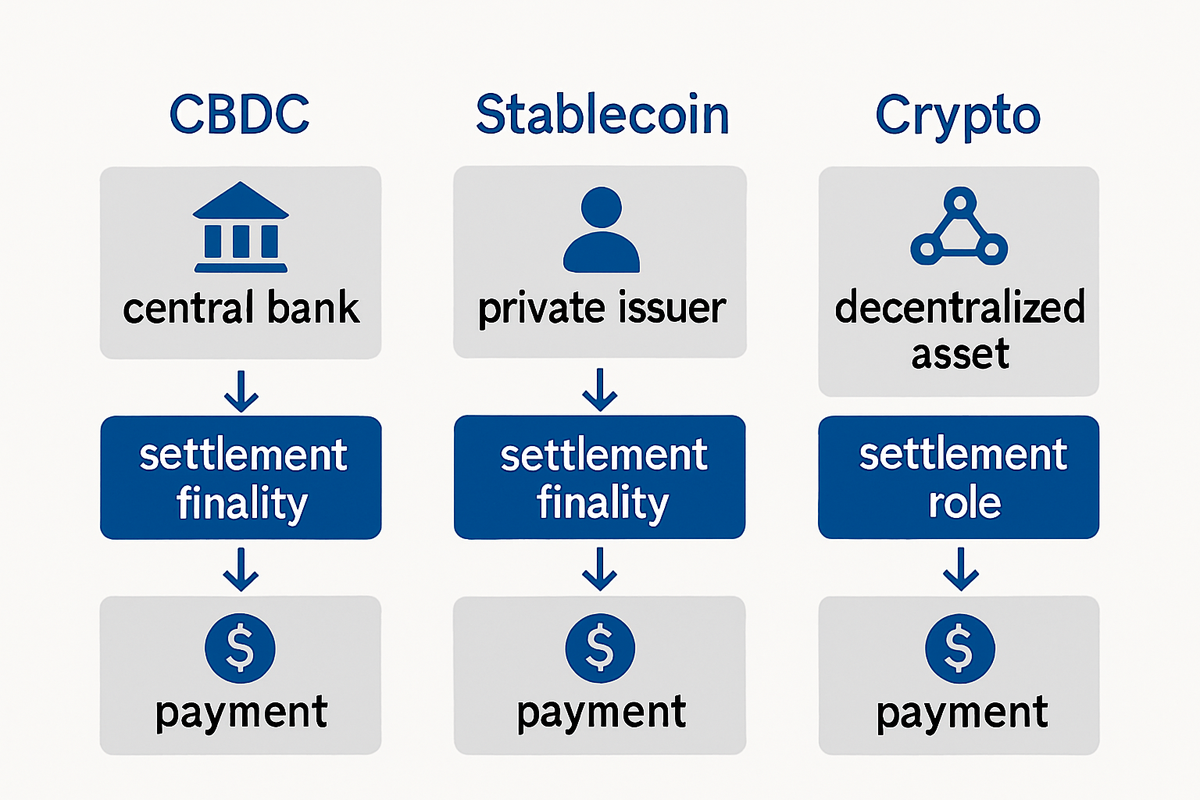
Central bank digital currencies are public money in digital form. The Bank for International Settlements describes CBDCs as an advanced form of central bank money with settlement finality, liquidity, and integrity. It says design will decide privacy and competition outcomes, and that cross border gains will need cooperation the BIS chapter on CBDCs.
Stablecoins are tokenised claims on an issuer that promise a stable value. They can be built for payments, but they remain private liabilities that must be backed and governed to avoid credit and liquidity risk. Crypto assets sit apart, since they are not money claims and do not offer issuer redemption. That makes them volatile and less suited to routine payments.
The European Central Bank frames this issue in payment system terms. A digital euro must meet aims on privacy, efficiency, and inclusion before it can gain broad use. Its impact on banks depends on choices about access and distribution the ECB’s report on a digital euro.
This taxonomy is not academic bookkeeping. It draws a clear line between final settlement in central bank money and settlement that relies on a private balance sheet. That line drives risk, fees, and trust.
| Instrument | Issuer | Settlement nature | Primary risks | Typical payment role |
|---|---|---|---|---|
| CBDC | Central bank | Final in central bank money | Design trade‑offs, bank intermediation | Retail and wholesale rails |
| Stablecoin | Private issuer | Tokenised claim on reserves | Credit/liquidity, governance | Cross‑platform digital payments |
| Crypto asset | Decentralised protocol | No issuer redemption | Volatility, scalability | Niche payments, investment |
For a deeper investor lens on this map, see Understanding Central Bank Digital Currencies: Implications for Investors.
Why this moment is different
Technology has removed a core bottleneck. A joint project by the Federal Reserve Bank of Boston and MIT showed a prototype. It processed up to 1.7 million transactions per second in tests, and had sub second finality under specific architectures Project Hamilton Phase 1.
Policy has converged on the need to modernise settlement and make cross border flows cheaper and faster. The BIS argues that CBDCs can improve cross border payments if jurisdictions coordinate on rules and interfaces. It also says careful data governance is central to trust the BIS chapter on CBDCs.
Demand has come from both sides of the market. Consumers have grown used to digital wallets. Institutions ask for lower friction and programmable settlement, and platforms see value in open rails. The ECB underlines that adoption is not automatic and hinges on design that aligns with clear user benefits the ECB’s report on a digital euro.
Add the network effects of large payment platforms and you get a window where technology, policy, and demand can push in the same direction. That is new.
Design choices that decide outcomes
Privacy and auditability sit in tension. A CBDC can be built to leave minimal data with the central bank, or to include tiered privacy with strong audit trails. The BIS highlights that governance choices will drive competitive outcomes and user trust. That makes data design a policy tool as much as an engineering one.
Access is another fork. Universal access supports inclusion, yet a direct retail CBDC may draw deposits from banks and alter their role in credit. The ECB sets out distribution models that rely on intermediaries and limits to balance privacy, efficiency, and financial stability.
Programmability sounds exciting, but it cuts both ways. Smart features can support conditional payments and automate compliance. They can also embed policy into money in ways that users may resist. Stablecoins bring their own design rules. Tokens used to settle money obligations should carry little or no credit and liquidity risk. That demands clear reserves and governance.
In each case, the edges matter more than the label. A system can be public in money terms yet private in how it handles data and access. It can also be the other way around.
The engineering reality: latency, scale, and what payments will feel like

Project Hamilton did not promise a national system. It was a test rig that showed what is possible under chosen trade offs. It reached very high throughput and sub second finality in a controlled setup. The team also discussed the trade off between scalability and auditability, and between privacy and keeping a history.
What does that mean for a person or a merchant. Payments can feel instant even at peak loads if the core can scale and settle fast. Retail apps can confirm with low latency. Wholesale systems can schedule liquidity with greater certainty.
Design still needs to balance speed with resilience. The path from a lab prototype to a live system includes fault tolerance, recovery, and observability. That is not a minor checklist. It is the difference between a fast toy and a safe rail.
Standards and interfaces will decide how these rails link across borders. The BIS stresses that cross border gains need cooperation on data and messaging. That is a governance problem before it is a code problem.
Financial stability and macro implications
A general purpose CBDC changes the balance between bank deposits and public money. Economic models suggest that easy access to central bank money can make panics less damaging, because deposits may shift earlier and more predictably. The same models warn of reduced maturity transformation in normal times if banks face persistent deposit outflows.
The ECB echoes the idea that distribution and holding limits can reduce unwanted shifts. That is why its report focuses on intermediated models and design levers that preserve bank roles while improving payment efficiency.
For central banks, the toolkit changes as well. A CBDC can deepen pass through of policy rates. A retail channel may give new data on money demand. Those gains come with trade offs on privacy and market structure. The BIS frames this as a public interest project that must protect integrity while allowing innovation.
For markets, the path is gradual. Investors should not expect one launch to upend the bank funding mix in a quarter. Design and limits will govern the speed.
For a strategy view on these shifts, see The Impact of Central Bank Digital Currencies on Traditional Portfolio Strategies.
Private rails and the incumbents’ playbook
Banks and platforms are not waiting for a final CBDC decision. Many are exploring tokenised settlement for intraday liquidity and cross border flows on shared ledgers. These efforts aim to cut friction where existing systems face time zones, batch windows, and fragmented messaging.
Payment networks frame new rails as complements, not replacements. A wallet can route over card, account to account, a future CBDC, or a well governed stablecoin, depending on cost and reach. That routing logic rewards open interfaces and consistent rules.
Corporate treasurers should prepare for settlement that can be conditional and near instant. Check how ready your treasury is for programmable settlement.
That means revisiting liquidity buffers, cut off times, and how cash visibility feeds into risk limits. It also means asking partners how they will handle token custody and software keys in mixed payment stacks.
Common misconceptions and the counterarguments
“CBDCs are surveillance by design.” Design decides data trails and who can see them. The BIS sets out models that preserve privacy by default while allowing targeted audit. That is a policy choice, not a technical fate.
“Stablecoins are the same as cash in the bank.” Stablecoins are only as safe as their reserves and governance. Principles applied to systemically important arrangements demand little or no credit and liquidity risk for tokens used to settle money obligations. That raises the bar far above a casual promise.
“Tokenisation removes the need for rules.” Tokens move on code, yet payments sit in a legal and operational stack. The ECB stresses legal clarity, consumer protection, and inclusion. That means new rails need old discipline.
“CBDCs will kill banks.” Models do not support an extreme view. Design can limit holdings and use intermediaries. That preserves the role of banks in lending and customer service while still upgrading the core of money.
Data driven signals to watch
This shift will be slow, yet it will be visible in the data. Track pilot outcomes and public updates on design choices. The ECB has set clear criteria for privacy, inclusion, and efficiency, and links adoption to how well those aims are met.
Technical benchmarks are another signal. A prototype has already achieved up to 1.7 million transactions per second in tests with sub second finality under specific assumptions. The same work notes trade offs between speed, audit, and privacy in the architecture Project Hamilton Phase 1.
Watch cross border cooperation. The BIS emphasises that gains across currencies will require shared standards and data governance agreements. Those should show up in joint work and aligned specs as much as in pilots the BIS chapter on CBDCs.
Institutional adoption will also leave marks. Expect more wallets that can route across rails, and more experiments with payment conditions built into invoices and contracts. Those are early, but they point to what the end state might feel like.
- CBDC pilots that report on privacy design and user take up.
- Measured latency and throughput under realistic fault scenarios.
- Cross border demos that use shared standards for messaging and data.
- Wallets that route across account to account, cards, and tokens.
- Stablecoin disclosures that detail reserves and governance.
A practical checklist for policymakers, banks, and businesses
For policymakers, start with privacy and data governance. Decide what data is collected at the core, who can access it, and under which legal triggers. Map how these choices affect competition and inclusion.
For central banks and supervisors, set clear guardrails for stablecoins used in settlement. Reserves should remove credit and liquidity risk at the token level, and governance should match the scale and reach of the system. Settlement finality and operational risk controls must align with financial market infrastructure standards.
For banks, rehearse disintermediation scenarios as part of liquidity risk management. Test deposit outflow paths under a live CBDC with holding caps, and plan new services that add value in a world where payment settlement is cheap and quick.
For businesses, prepare the plumbing. Treasury and payments teams should plan for instant settlement, program conditions, and mixed custodial setups. That includes key management, integration with enterprise resource planning, and clear recovery processes.
The decisions are practical. Use them as a guide to brief your board and vendors.
- Privacy by design, with tiered access and auditable triggers.
- Reserve robustness and disclosure for payment stablecoins.
- Settlement finality guarantees that cover normal and stress states.
- Interoperability standards for cross border and cross platform use.
- Liquidity and treasury processes tuned for instant settlement.
If you need an investor angle, see The Role of Central Bank Digital Currencies in Shaping Future Investment Strategies and Digital Currencies and Inflation: Adaptations for Quantitative Investment Strategies for portfolio level implications.
Conclusion: realistic timelines and next steps
The future of payments will not arrive in a single switch. It will arrive in modules, pilots, and overlays. These will make some links instant and others cheaper, then expand. The BIS and the ECB both stress design and cooperation as the core drivers. That is why timelines are measured in phases.
The path is still clear. Public money can gain a digital form that preserves its special role in settlement. Private tokens can find a place where they add reach, speed, and programmability under rules that manage risk. Users care about cost, speed, and trust, and those are the levers a well designed system can pull.
So what should you do now. Map your exposure to payment rails, list your design choices on data and custody, and run the liquidity and operational drills that an instant world demands. Take the first step today with a pilot that tests one feature end to end.
Related reading
- Understanding Central Bank Digital Currencies: Implications for Investors
- The Impact of Central Bank Digital Currencies on Traditional Portfolio Strategies
- The Role of Central Bank Digital Currencies in Shaping Future Investment Strategies
- Digital Currencies and Inflation: Adaptations for Quantitative Investment Strategies