Fintech in asset allocation is not a single product. It is a stack. Think AI and machine learning for signals, optimizers that learn end to end, robo‑advisors that monitor drift and rebalance, and enterprise platforms that stitch public and private data into one view. That mix is what now shapes how portfolios get built, checked, and changed.
The aim is simple. Make allocation more informed, more automatic, and more integrated. The path is less simple, and it comes with frictions to manage.
Why this matters now
The performance case has moved from promise to evidence. An end‑to‑end portfolio approach that learns forecasts and weights together can beat the classic two‑stage pipeline on risk‑adjusted results, as shown in NBER Working Paper w34861.
The enterprise case is scale and visibility. Large platforms standardize data and use analytics across public and private markets, which helps set weights at the whole‑portfolio level rather than by silos. That is the stated aim of industry systems that bring private assets into the same lens as stocks and bonds.
The retail case is access and discipline. Robo‑advisors use questionnaires to map risk, monitor daily, and rebalance based on set drift bands such as 5 percent. Fees are low and choice is narrow, so investors get a clear path and fewer ways to self‑sabotage.
A 2024 review by a major policy institution expects broader use of model‑driven processes in asset management. It also warns that opacity and feedback loops can rise with adoption. That tension will define the next phase.
The mechanics: how fintech reshapes decisions
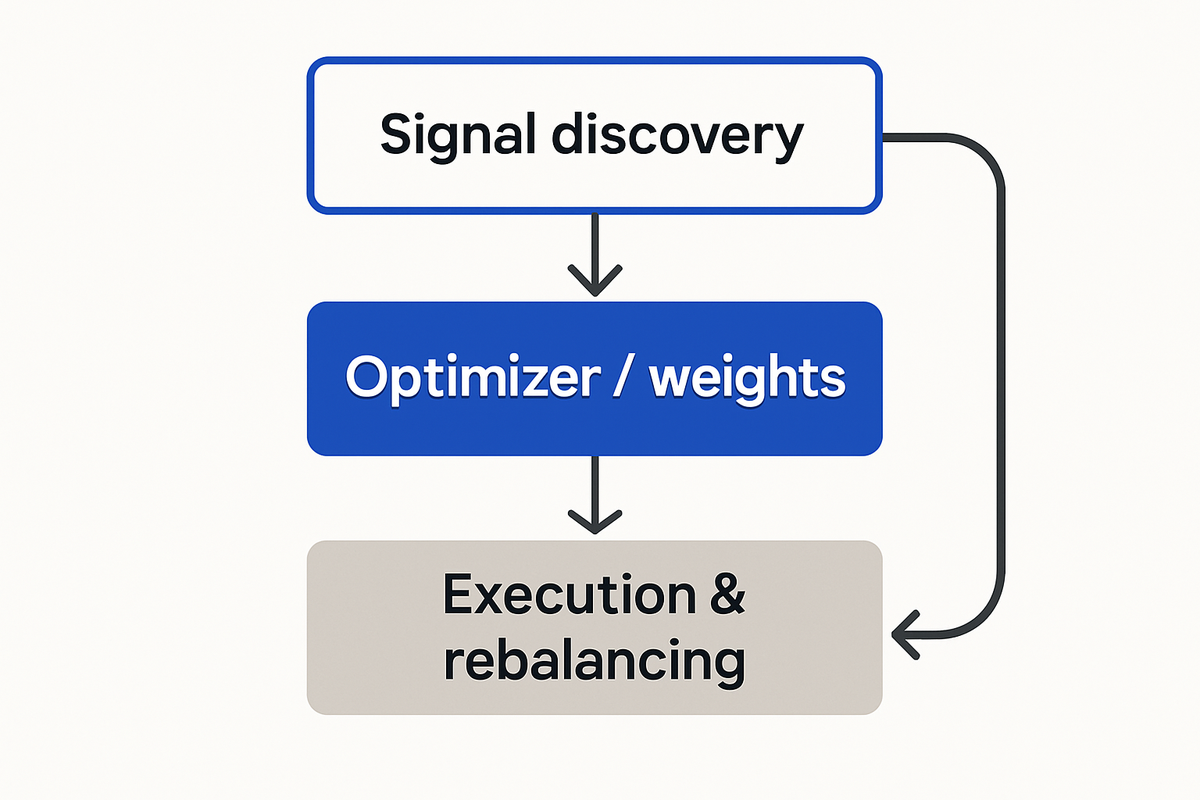
Fintech changes allocation at three points. It improves the signals that feed the decision. It changes the optimizer that turns views into weights. It automates execution and rebalancing once the plan exists. Each link matters.
Signal generation
Machine learning expands the menu of features and lets models learn non‑linear links. That helps build cleaner return estimates and more stable risk inputs. Peer‑reviewed surveys find gains across signal discovery, portfolio formation, and trade execution, yet they also flag the need for clear model checks and explainable logic.
This is not about exotic networks alone. Robust feature engineering and careful validation can lift even simple learners. The goal is not a miracle forecast. It is to cut noise in the inputs that flow to the next step.
Optimizer design
Traditional pipelines forecast returns or risks, then plug them into mean‑variance math. That split can amplify errors. Recent work shows value in end‑to‑end training, where the optimizer is part of the learning loop and the loss aligns with portfolio goals. Evidence of better risk‑adjusted outcomes comes from integrated designs that learn forecasts and weights together, as in the study above.
Other lines of work avoid brittle steps in the classic approach. A bottom‑up machine learning method sidesteps inverting a noisy covariance matrix and reports robust gains in U.S. and China equity tests, as shown in a 2020 arXiv paper on ML asset allocation.
The thread is the same. Better alignment between learning and the end objective tends to help, and so does building around estimation error rather than wishing it away.
Execution and rebalancing
A plan is only as good as its upkeep. Retail platforms monitor portfolios daily and trigger rebalancing when drifts pass set bands like 5 percent. That system bakes discipline into daily practice, without the need for constant user action.
At the institutional scale, integrated platforms bring positions and exposures into one place across public and private assets. They support cross‑asset rebalancing and stress tests, which makes whole‑portfolio policy possible in real time. Data standards sit behind that promise.
Check how disciplined your portfolio really is.
| Allocation stage | What fintech changes | Example tool | Evidence source |
|---|---|---|---|
| Signal generation | Rich features, non-linear learning, better inputs | ML models | Frontiers review (2024) |
| Optimizer design | End-to-end learning aligned to portfolio loss | Integrated ML | NBER w34861 (2026) |
| Risk/estimation | Robustness to noisy covariances | Bottom-up ML | arXiv 2011.00572 (2020) |
| Execution | Automated monitoring and drift bands | Robo‑advisor | Vanguard product details (2024–25) |
| Governance | Whole‑portfolio view and stress tests | Enterprise platform | Aladdin insights (2025) |
For investors who test models, the pitfalls look familiar. Backtests need guardrails on leakage, regime splits, and costs. See the role of validation in machine learning for enhanced backtesting and how to handle shocks in advanced backtesting under uncertainty.
Who gains and who does not
Lower costs and simpler access are real. Yet the gains are not shared by all users in the same way. Evidence shows that more sophisticated or digitally fluent investors often benefit more from the same tools, according to a 2023 BIS working paper on fintech and portfolio choices.
Interface design and literacy shape outcomes. If a questionnaire nudges a user into an equity‑heavy mix during a boom, that choice may stick into a drawdown. The Behavioral Economics Guide highlights loss aversion, narrow framing, and status‑quo bias that can tilt long‑term choices.
Robo products also vary behind clean screens. A 2022 industry review found broad use of ETFs, different risk maps, and gaps in how providers explain investor mapping and allocation rules. The result is that two users can get different portfolios for the same stated risk.
This heterogeneity is not a flaw by itself. It is a reminder that low fees do not solve fit, and that clarity on process still matters.
Common misconceptions and overstated claims
Myth one: machine learning is a cure for estimation error. In truth, design can reduce error sensitivity, but models still face noisy data and regime shifts. A bottom‑up approach may help when covariances are unstable, yet it does not erase risk.
Myth two: robo‑advice replaces human judgment. Robo workflows handle monitoring and rebalancing well. They do not replace nuanced planning on taxes, illiquid assets, or life events.
Myth three: models are transparent by default. A 2024 policy review warns that model logic can be hard to explain at scale, and that many systems are black boxes to end users. Explainable AI helps, but it is a goal to work toward, not a given today.
A small myth also spreads fast. People assume that automation means the right goals are baked in. Automation locks in whatever goals you choose, and some goals do not age well.
Evidence and case studies
End‑to‑end ML portfolio construction shows promise. Evidence points to a lift in risk‑adjusted results over a two‑stage forecast‑then‑optimize flow. The same study frames the gain as an outcome of aligning data, loss, and weights in one training loop.
Robustness matters in practice. A bottom‑up ML method that avoids inverting a noisy covariance matrix reports excess returns in U.S. and China equities, and this suggests a path around a classic pain point, as shown in the 2020 arXiv allocation paper.
Institutions move on data and views. Enterprise platforms use machine learning and data standards to give a unified lens across public and private assets. That enables cross‑asset risk analytics and rebalancing in one place.
Robo‑advisors bake in steady habits. A clear risk questionnaire sets the map, and daily checks with drift bands around 5 percent keep the mix on track. Morningstar’s 2022 review notes that fees are often low, yet transparency about mapping and long‑term fit can differ across providers.
Investors who fold digital assets into the mix face added risk. For a deeper dive into that ecosystem, see our guide to navigating digital asset risks.
Risks, systemic effects and regulatory challenges
Model‑driven allocation can cluster decisions. If many systems learn from the same data and features, they can buy and sell in lockstep. A 2024 policy review flags this herding risk and notes the feedback loops it can create in stressed markets.
Opacity is a second concern. When models and data pipelines are complex, even insiders can struggle to explain why a given allocation moved. That makes supervision and client reporting harder, and it clouds accountability.
The review also stresses governance. Explainability, model testing, and clear boundaries for use are not optional. They are core parts of any process that can move billions with one line of code.
The goal is not to slow the tools. It is to match speed with control, so scale does not become fragility.
Counterarguments and limits to the upside
Some say the upside is overstated. They note that results depend on data quality, careful evaluation, and fair access. The broader literature agrees and points to uneven gains when digital literacy is low.
Others point to regime shifts. A model trained on one decade can falter when macro drivers flip. That is a call for stress tests, robust losses, and periodic checks rather than a reason to avoid models.
Design choices matter more than slogans. The same method can help or hurt based on targets, constraints, and rebalancing rules. Simpler can be stronger when uncertainty is high.
Behavior also matters. Loss aversion and narrow framing can push users to override plans at the worst time. For tools to work, they need good defaults and clear prompts, which we explore in our piece on investor psychology in volatile markets.
A short toolkit for stakeholders
For investors: ask for clarity on how your risk is mapped and how the model explains trades. A summary of model logic and inputs is a fair request. If you cannot get it, consider a simpler plan you can live with.
For advisers and platforms: blend ML signals with behavioral design that reduces common frictions. Use clear progress cues, sensible defaults, and friction at exit to slow panic selling. Questionnaires should test for stability, not just short‑term fear or hope.
For institutions: invest in data standards and a single book of risk across public and private assets. Whole‑portfolio analytics support better rebalancing and mandate checks. They also speed up stress tests when they matter most.
For regulators: focus on model governance, explainability, and stress testing. Clear reporting standards on investor mapping, drift rules, and data sources can raise the floor without freezing progress.
Ask your provider for model documentation and rebalancing logic this week.
Closing synthesis: promise and prudence
The literature lands on a balanced view. Fintech can lift the precision of allocation, improve risk discipline, and scale whole‑portfolio views. It can also widen gaps across investors and add opacity at scale.
End‑to‑end ML can improve risk‑adjusted results, and bottom‑up methods can blunt estimation error. Retail tools turn discipline into a default, while enterprise stacks make private and public speak the same language. These are real gains.
Yet the gains are conditional. They depend on data, model design, explainability, and access. When those supports are weak, the tools can mislead or exclude.
The task now is clear. Keep the upside by hardening the process and broadening access. Do that, and allocation gets both smarter and fairer.
Related reading
- Leveraging Machine Learning for Enhanced Backtesting in Quantitative Strategies
- Advanced Backtesting Techniques for Quantitative Strategies in Uncertain Times
- The Role of Investor Psychology in Volatile Markets: Strategies for Resilience
- Navigating the Risks of Digital Asset Investments: Strategies for Modern Investors