Artificial intelligence promises to spot trouble before it spills into a crisis. It also threatens to push many actors toward the same exits at once. Both ideas can be true. The interesting work lies in the middle ground.
This piece looks at how AI is used to flag systemic risk. It assesses the evidence on accuracy. It covers where the technology might amplify the cycle. We draw on central‑bank research and practitioner studies. We end with a practical toolkit for those building or regulating early‑warning systems.
What we mean by “AI for financial‑crisis prediction” — scope and vocabulary
In this article, “AI for crisis prediction” means early‑warning systems that use machine learning. They estimate the probability of systemic stress over horizons from quarters to a few years. The classic reference point is an econometric signal or logit model that flashes red when indicators breach thresholds. ML extends that toolbox with non‑linear patterns, interactions, and model ensembles.
Two adjacent tool families matter but serve different aims. Nowcasting and sentiment systems infer the present, often from text. They help monitor conditions when hard data lag. Generative AI assistants structure analyst workflows. They are not forecasters on their own.
The Bank for International Settlements shows how an online model‑averaging approach can improve out‑of‑sample crisis detection. The paper also shows which model families contributed most to signals in major European economies. See BIS Working Paper No. 926 BIS Working Paper No. 926.
A recent review finds that tree‑based methods such as random forests and gradient boosting dominate the EWS literature. It also stresses data limits and explainability, and that prompts many teams to pair ML with economic judgement. Practitioner surveys echo the point that finance is a small‑data domain where robustness beats cleverness.
Why this matters now — the technology and market inflection point
AI adoption in finance has entered a new phase. Foundation models and tooling are widely available. Data exhaust from payments, messaging, and alternative sources is denser and timelier. That combination creates new inputs for monitoring and a faster path from signal to action.
The same shift raises systemic questions. The European Central Bank warns that common suppliers, correlated strategies, and procyclicality can transmit small modelling errors into large market moves. It says this even as AI brings efficiency gains and better indicators for sentiment and nowcasting ECB Financial Stability Review special feature.
Policy work from international institutions highlights the dual nature of near‑term adoption. Better analytics can reduce some risks in risk management and supervision. Yet concentration, model herding, and vulnerability to adversarial manipulation can add new channels of stress.
There is also a human layer. Faster models meet the same crowd psychology that drives panics and recoveries. For how sentiment cascades in volatile markets, see The Role of Investor Psychology in Volatile Markets: Strategies for Resilience.
How AI EWS are built — methods, data and evaluation frameworks
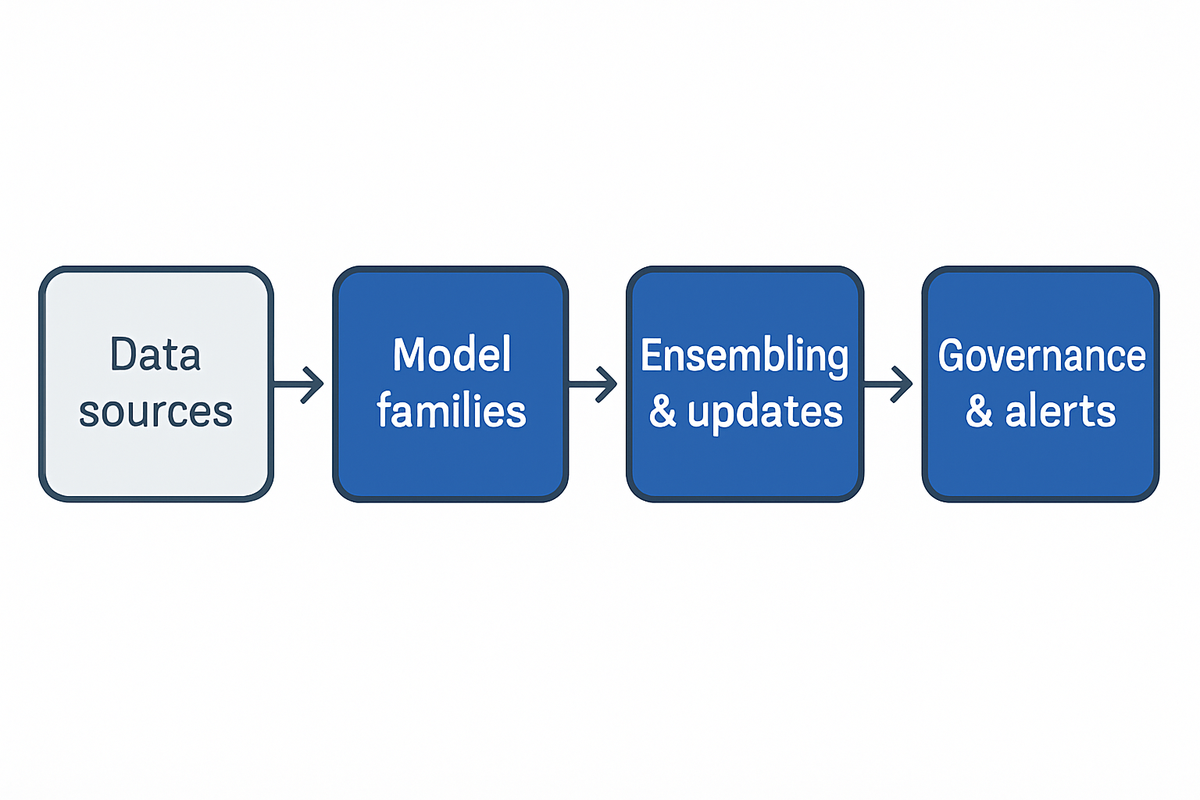
Most crisis EWS boil down to a supervised learning setup. The target is a binary or multi‑state crisis label. The features mix macro and financial indicators with market measures, plus text‑based signals from news, filings, or social media.
Model families are familiar: random forests and gradient boosting capture non‑linear splits and interactions. Neural networks can learn richer functions. They need care in small samples. Ensemble and online model‑averaging frameworks combine multiple learners and update weights as new data arrive.
Three engineering disciplines shape performance. Feature design that encodes economic intuition, like ratios, gaps, and growth rates, makes patterns more stable. Cross‑validation must respect time with rolling or expanding windows to prevent leaks, and online evaluation tracks how the model would have behaved as information accrued.
Text models add a complementary layer. Domain‑tuned sentiment models, or embeddings that track topics, can map shifts in tone across sectors and jurisdictions. They are not a forecast on their own. They often help filter noise in macro indicators.
To anchor these ideas, here is a compact build map. It lists common components and choices.
| Component | What it does | Typical choices / notes |
|---|---|---|
| Target labels | Define crisis windows | Systemic banking stress flag, currency crisis tag |
| Features | Encode economic signals | Credit-to-GDP gaps, leverage, funding spreads, house prices, text sentiment |
| Learners | Map features to risk | Random forests, gradient boosting, shallow neural nets |
| Ensembling | Stabilise predictions | Simple averaging, stacking, online weight updates |
| Validation | Estimate real-time skill | Rolling windows, walk-forward splits, cost-weighted metrics |
| Monitoring | Keep models healthy | Drift checks, attribution, challenger models |
BIS research shows the value of an online ensemble frame. Practitioner notes add a caution. Without disciplined validation and attribution, model upgrades can degrade real‑time skill. That is one reason many banks run ML EWS parallel to simpler benchmarks.
What the evidence says about predictive performance — gains and hard limits
The balance of recent evidence is constructive. Many studies find that ML extracts more signal than classical thresholds or linear logits, especially when interactions matter. Gains tend to be clearest for ranking risk across countries or sectors rather than pin‑point timing.
Yet the false‑alarm and timing trade‑off remains stubborn. A classic review of signal‑based early‑warning systems finds mixed results, real diagnostic value, and large costs from wrong or early calls. That implies careful calibration and robustness checks for each country and regime the Federal Reserve’s IFDP evaluation.
Rare events are a core constraint because crises are infrequent and heterogeneous, so the sample available for training is small. That invites overfitting and unstable thresholds. Many teams therefore evaluate success not as “we called the crisis” but as “we improved the ranking and gave supervisors months of earlier visibility.”
Text helps at the margin. Sentiment and topic indicators often improve nowcasts of stress conditions and can reduce false positives when economic data wobble. They can chase noise if not anchored to domain knowledge and a clear horizon.
Check how disciplined your portfolio really is. Run your own “would‑we‑have‑listened” audit on past false alarms.
Systemic channels where AI can amplify or mitigate crises
AI can mitigate crises by improving visibility, standardising surveillance, and surfacing weak links earlier. Better monitoring lets supervisors pace interventions and firms trim exposures before stress compounds. That is the upside when models are diverse and governance is tight.
The downside runs through concentration and correlation when many actors rely on a handful of suppliers or benchmarks and small errors propagate. The ECB highlights common suppliers and procyclicality as central channels, and it points to correlated strategies as a mechanism that can amplify a shock.
Operational and data risks add further paths because model pipelines depend on data integrity and secure infrastructure. Poisoned data or disruption can yield confident but wrong signals at scale, so policy work urges tests that include such adversarial scenarios, not just market stress.
Behavior magnifies technical effects. If a wave of similar signals arrives at once, crowded exits follow. For a wider view of how crowding and bias shape outcomes under stress, see Behavioral Biases in Times of Market Stress: Lessons from Recent Crises.
Case studies and practitioner evidence — what institutions report in practice
BIS work with European economies offers a concrete picture of model diversity, where different model families contributed differently across time and countries and online averaging helped smooth regime changes. The takeaway is methodological: let multiple views compete.
Practitioners report measurable gains in specific tasks, noting that text‑based event forecasting and sentiment extraction can add accuracy when paired with domain data, tuning, and human oversight. Teams stress the basics: data quality, explainability, and disciplined model updates matter as much as raw model class.
Policy surveys add context on adoption paths. Market participants expect automation to rise in monitoring and risk control. They also expect rules on supplier oversight, documentation, and stress testing to tighten as toolchains grow more complex.
Finally, institutions frame human‑plus‑machine designs as the practical default, with analysts using AI to triage information and expert committees arbitrating signals and deciding when to lean against the model. That hybrid tends to travel better across regimes than a pure black box.
Common misconceptions and overclaims to avoid
“AI will call the next crisis” is an overclaim. Even strong models face data scarcity, shifting regimes, and strategic behavior by market participants who learn from the tools. The right bar is not clairvoyance. It is earlier, cleaner visibility of mounting risk.
“More complex is better” is another trap. In small‑data finance, simpler models with clear features often beat deep stacks in out‑of‑sample use. Practitioners warn that complexity taxes implementation and monitoring, yet adds little unless the data and the economics support it.
“LLMs understand finance” invites trouble. Large language models read and write, but they hallucinate. Their embeddings reflect training data quirks. Without domain calibration, supervision, and guardrails, they can generate spurious signals that look plausible and are very wrong.
“Explainability can wait” is a governance error. Supervisors and boards need attribution for model outputs, especially for decisions that tighten credit or raise capital. Attribution also helps modelers debug drift before it shows up as public error.
Counterarguments and healthy scepticism — why ML EWS sometimes fail
Small data sinks many projects. Crisis labels are sparse, and cross‑country pooling can blur institutional detail. Without careful design, models learn the idiosyncrasies of one episode and misfire in the next.
Regime shifts cut both ways by breaking patterns that powered yesterday’s model and by making calibration from past crises hard. Early warning can then degenerate into early noise, which is why rolling validation and challenger models have become standard practice.
Implementation costs are real. Integrating data feeds, building monitoring, and keeping humans in the loop requires time and budget. Some teams prefer well‑understood scorecards that they can explain to boards and regulators over a marginal accuracy gain from ML.
Finally, market participants adapt. If many firms watch the same indicators, signals leak into prices earlier. That can be good if it means smoother adjustment, or bad if it triggers automated deleveraging into thin liquidity.
Practical toolkit for deployment and regulation — governance, testing and macroprudential guardrails
You cannot regulate or manage what you do not measure. Start with disciplined backtesting that reflects the information set available at the time. Track both hits and false alarms. Use cost‑weighted metrics that reflect the asymmetry between missing a crisis and crying wolf.
Model‑risk management comes next. Require clear documentation of features, data lineage, and validation choices, and build attribution and reason codes for every signal. Mandate challenger models and run‑time drift checks, not just annual reviews.
Supplier concentration needs attention. Map your dependencies and create fallbacks for model hosting, data, and key libraries. Supervisors can require critical‑supplier oversight and stress tests that include model unavailability and corrupted data.
Finally, embed AI EWS as complements to expert judgement, using committee structures that weigh model outputs with supervisory intelligence and reflect the cautious stance regulators advise. The ECB suggests AI tools are useful for sentiment and nowcasting but says they should remain complementary to expert judgement the ECB’s special feature conclusion.
Here is a compact checklist you can adapt to your context. Use it as a starting point.
- Define horizon and use‑case, then align labels and metrics to that horizon.
- Design features with economic meaning; avoid raw levels without context.
- Use rolling, walk‑forward validation; never mix future data into training.
- Ensemble diverse models and track online performance against challengers.
- Build explainability and reason codes into every signal and report.
- Map supplier dependencies and plan fallbacks for data and hosting.
- Stress test for adversarial data, outages, and herding under common shocks.
- Integrate expert committees that can override or ratify model calls.
Want an outside view on your model‑risk posture? Schedule a pre‑mortem and test how your stack behaves under silence, noise, and false certainty.
Conclusion and research agenda — what to watch next
The role of AI in predicting financial crises is best seen as disciplined augmentation. ML EWS can sharpen the picture and move the clock forward by a few quarters. They cannot remove uncertainty or the need for human arbitration.
A useful research agenda starts with better data. We need standardised benchmarks and shared, well‑documented crisis labels that capture institutional detail. Text corpora aligned with event timelines would help, as would metadata on interventions and spillovers.
Stress scenarios should evolve too. Data‑poisoning, cyber outages, and supplier failures deserve a place next to market shocks in supervisory playbooks. We also need tests for herding when many actors rely on similar models.
Finally, human‑plus‑AI hybrids look most promising. Designs that preserve interpretability, exploit ML’s pattern capture, and respect small‑sample limits are more likely to survive the next regime shift. That is a sober, and useful, definition of progress.
Related reading
- The Role of Investor Psychology in Volatile Markets: Strategies for Resilience
- Behavioral Biases in Times of Market Stress: Lessons from Recent Crises
- The Role of AI in Forecasting Market Trends: What Investors Need to Know